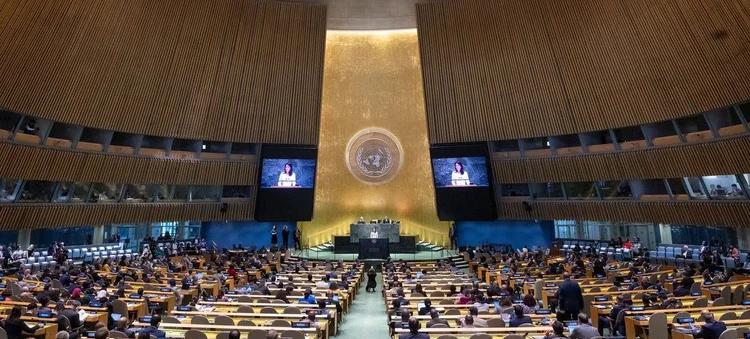
US Supports United Nations Declaration on Sea Level RiseThe United Nations adopted on September 24 by consensus a Declaration on Sea Level Rise promoted by Pacific Island Nations. The United States did not object to approval of the declaration. Grist explains that the declaration is intended to protect the sovereignty of island nations who loose their land to rising seas: It had never been clear what would happen to those sovereign nations. Under the agreement, those states will continue to exist as political actors even if their landmass disappears. They’ll also retain control over their old maritime borders, the stretch of sea extending from the coastline over which a country has exclusive control for fishing, energy development, and other military and economic activity. Thriving Economy Project Offers Resilience PoliciesThe Thriving Economy Project, developed through the Sustainable Energy and Environment Coalition Institute, has published a report outlining policy options in diverse areas, including community resilience. The report is the work of Democratic Members of Congress and a range of policy experts. Some of the key recommendations in Chapter 3 of the report relate to community resilience and climate adaptation and include: Establish a coordinated federal climate-migration framework, anchored by a designated lead agency and a permanent community-led relocation program; Reduce barriers to the planned transition from areas of greatest risk to safer areas by deploying federal funding and technical assistance; Support origin communities in planning for property conversion to open space, restoration, or risk-reducing uses; and Standardize federal data, risk disclosures, and a single point of entry for buyout and relocation program applicants to reduce administrative burden.
Recommendations in other chapters relate to risk communication, protection of disadvantaged communities, infrastructure development based on future conditions, and ecosystem protection. Racial Inequities Plague FEMA Buyout ProgramA new report from the National Bureau of Economic Research found that the Federal Emergency Management Agency Hazard Mitigation Program buyouts concluding: We find that the buyout compensation received by households of color is at least 6 percent lower than that received by white households. White participants relocate to higher quality neighborhoods and are better off than white nonparticipants. Black participants, on the other hand, move to worse neighborhoods and are worse off than Black non-participants The New York Times provides background information and quoted a study author: “Policymakers have considered expanding buyout programs and purchasing homes before disaster hits. If they don’t fix the payment gap, ‘these unequal impacts are going to be magnified,’ Dr. Ma said.” Climate Impacts Drive Affordability CrisisThis new report from Rebuild by Design, a project of New York University, describes how extreme weather is a “hidden cost” that drives the affordability crisis, noting: The financial impacts of extreme weather events on households strain savings, disrupt livelihoods, and deepen inequalities, adding to an already critical affordability crisis. Despite these events increasing in frequency, severity, and public visibility, households/individuals across the country are not financially prepared for the long term effects of weather such as sea level rise, nor the next weather disaster. Flood insurance and property insurance rate increases, storm recovery costs, and displacement as a result of flooding all contribute to extreme weather costs. House Passes WRDA 2026On September 16, the U.S. House of Representatives approved the 2026 Water Resources Development Act by a vote of 415 - 9. This press release from Committee Chair Rep. Sam Graves explains: WRDA 2026 makes significant improvements across the country to our inland waterways, ports and harbors, flood protection, and other critical water infrastructure. This bill also makes common-sense reforms to the Army Corps of Engineers’ policies, empowers local communities, and expedites project delivery… A key section of the bill addresses coastal storm risk management studies (i.e., Section 132) and includes sea level rise among other factors to be considered and calls for equal consideration of structural and nonstructural measures. For the legislative text of the House passed WRDA 2026, click here. For a summary of WRDA 2026, click here. The Senate Environment Committee reported a WRDA bill in July. State Authority Under Coastal Zone Management at RiskThe Department of Commerce has reopened a near final review of the Coastal Zone Management Program in California, citing “multiple unfounded objections to spaceport-related proposals by the U.S. Air Force.” Christine Todd Whitman, served as governor of New Jersey from 1994 to 2001 and administrator of the U.S. Environmental Protection Agency from 2001 to 2003, wrote in The Hill newspaper raising concerns about possible loss of state authority to object to federal actions that the states finds to be inconsistent with an adopted state CZMA plan. This formula for success falls apart if Washington can supplant California’s priorities with its own, especially if the Trump administration’s rush for new offshore drilling results in oil spills. We’ve seen time and again that such spills close fisheries, beaches and harbors, and transform vibrant coastal communities into ghost towns overnight. The Moral Hazards of Minimum StandardsIn this reflection on choices communities must make in managing flooding, Chad Berginnis, Director of the Association of State Floodplain Managers (ASFPM), outlines the moral hazards that officials confront when they opt for minimum standards. He outlines some of the issues with failing to choose safer, more protective standards, including: Lower Costs, Higher Danger: buildings are cheaper to build initially but risks and costs pass to others (“After the house is built and sold, most builders are off to build the next subdivision, unburdened by the legacy risk that they may have left behind.”); False Security: the idea that a property is safer, and more valuable than it is, often leading to unexpected future costs or losses; and Transfer of Recovery Cost to the Public: this occurs both as conventional disaster assistance but includes many, smaller costs and disruptions that are rarely assessed. FEMA’s “Perverse Incentives” Drive Loss of Homes and Beach Debris HazardsColorado Public Radio reports on the growing number of homes lost to flood hazards and the public health risks that result from debris generated when homes are destroyed, explaining: FEMA provides most residential flood insurance in the United States. The agency will pay homeowners after a house collapses, but not before. That means owners stand to lose tens or even hundreds of thousands of dollars by tearing down a doomed house before the ocean takes it. "The homeowner is incentivized to wait for collapse and get a payout," says John Ryan-Henry, a policy analyst at the Coastal States Organization, a nonprofit that advocates on behalf of coastal state governments, including those along the Great Lakes. And when homes collapse, they pollute the water and leave wreckage on the shore. "People should not have to wait for their home to collapse into the water before they can get help," says Rep. Chellie Pingree, D-Maine. "That is just not a smart way to deal with the reality of climate change." This video from NPR shows loss of homes to the sea. Coastal Debris Poses Health HazardsNPR reported on the environmental and health risks resulting from the loss of homes along beaches as debris is spread for miles along beaches. You're talking about very large and, in some case, hazardous building debris - pilings, washers, dryers, jacuzzis. In many cases, within, let's just say, 24 hours of the house collapsing, we can have debris that's already spread 10 miles or more. Coastal management experts point out it's possible to prevent a lot of this pollution. It's pretty clear which houses are threatened. They could be removed before they wash away, which most people can't afford to do, and new houses would need to be built in places that are safe from rising seas.
|